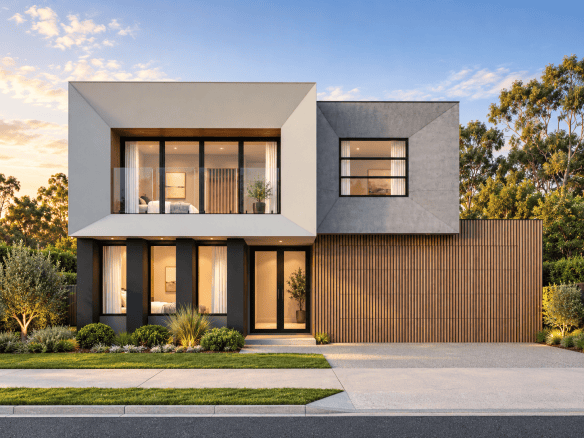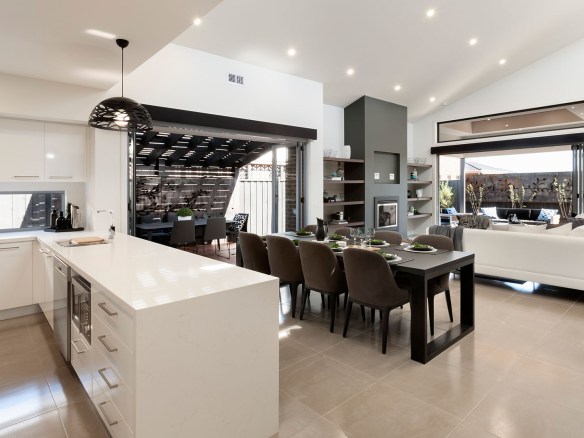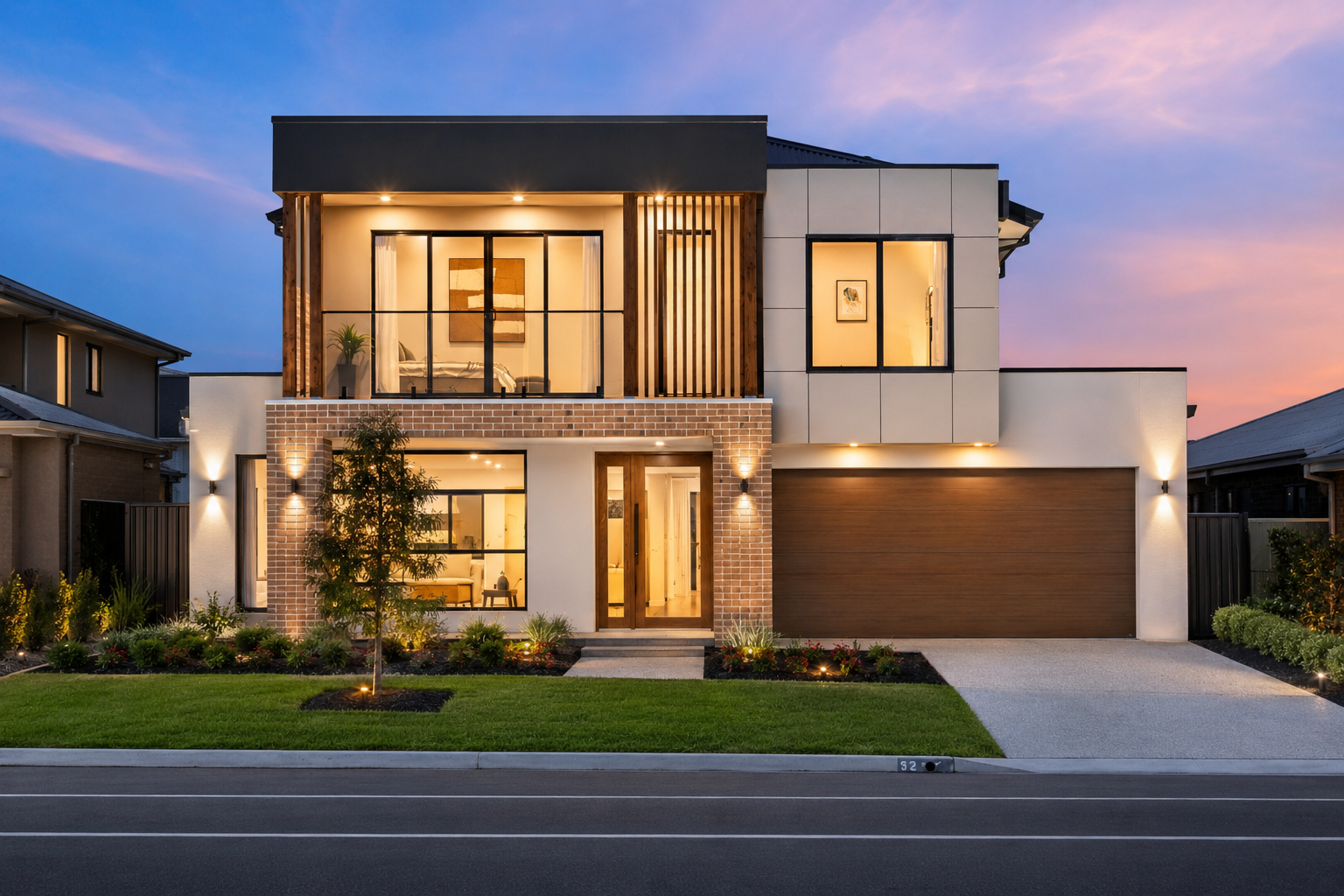
According to the AIQS Building Cost Index benchmark, building a house in Melbourne with a project builder costs around $1,800 to $3,500 per square metre in 2026, before land.
For a four-bedroom double-storey home of around 250 to 300 square metres, that puts a realistic build budget at roughly $550,000 to $850,000, once site costs and the inclusions most families expect are accounted for.
Where your home falls in that range depends on its size, design, finishes and block. It also depends on how your builder prices, because two quotes that look $60,000 apart at the start can end up much closer, or swap places entirely, by the time the contract is signed.
What Moves Your Build Cost Up or Down
Before comparing home builders, it helps to know which decisions have the biggest effect on price:
- Size. Floor area is the largest single driver. A few extra squares across a double-storey home add up quickly.
- Design complexity. Voids, larger spans, more corners and complex rooflines take more materials and labour than a simpler shape.
- Your block. A flat, regular block with good access is cheaper to build on than a sloping, narrow or rocky one.
- Finishes and selections. Benchtops, flooring, tapware and appliances vary enormously in price.
These aren’t reasons to compromise on the home you want. They’re simply the factors worth understanding when a quote comes in higher or lower than you expected.
How a Low Headline Price Is Built
A headline price is the figure you see on a brochure, a billboard or a display home sign. It’s usually the price of the base design, with the base facade and the base inclusions, on an ideal block. That’s not misleading in itself, but it means the number is a starting point rather than an estimate of what you’ll pay.
The gap between a headline price and a final contract price usually comes from a few places:
- Minimal base inclusions: Items many buyers assume are standard, such as stone benchtops, larger tiles, higher ceilings or heating and cooling, may be priced as upgrades.
- Facade upgrades: The facade on the brochure isn’t always the facade included in the base price.
- Site costs: Soil classification, slope, rock, drainage and service connections can all add cost once your block is assessed.
- Energy compliance: New Victorian homes must meet a 7-star energy rating, and the glazing, insulation or design changes needed to achieve it on your block can add to the price.
- Provisional sums and prime cost items: These are allowances for work or items that can’t be precisely priced yet. If the real cost comes in higher, you usually pay the difference.
- Selections: Colour and selection appointments are where many buyers find their preferred options sit outside the standard range.
Individually, each of these may be reasonable. Together, they’re why the cheapest quote at the start isn’t always the cheapest house at the end.
What Goes Into the Cost of a New Home
| Cost item | What it covers | Often in a headline price? | What to ask |
|---|---|---|---|
| Base house | The home as designed, with standard inclusions | Yes | Can I see the full inclusions list for this price? |
| Facade | The front elevation and its materials | Base facade only | Is the facade I’m looking at included? |
| Site costs | Soil test, excavation, slab type, retaining, drainage, service connections | Sometimes, or as an allowance | Are site costs fixed, estimated or confirmed after a soil test? |
| Internal inclusions | Kitchen benchtops and appliances, flooring, ceiling heights, heating and cooling, bathroom fittings | Varies widely between builders | Which of these features are standard and which are upgrades? |
| Energy compliance | Glazing, insulation and other measures to meet the 7-star requirement | Varies | Is 7-star compliance included for my block and orientation? |
| Provisional sums and prime cost items | Allowances for work or items not yet priced exactly | Included as allowances | How many allowances are in the contract, and how realistic are they? |
| External works | Driveway, landscaping, fencing, letterbox, clothesline | Often not | What will I need to budget for after handover? |
| Contingency | A buffer for selections and unexpected costs | No | What do your clients typically spend beyond the contract? |
Myths vs Facts About Builder Pricing
Myth: The builder with the lowest advertised price will build the cheapest home.
Fact: The advertised price reflects the base design and inclusions. The final price reflects your design, your block and your selections. Compare final figures, not starting figures.
Myth: Upgrades are optional, so they don’t really count.
Fact: Some upgrades are a matter of taste. Others, like site works or energy compliance, aren’t optional at all. Ask which items you’ll realistically need on your block.
Myth: A fixed price means nothing can change.
Fact: A fixed price contract locks in the price of the work described in it. Changes you request, or genuinely unforeseen site conditions, can still affect the cost. The more detail in the contract, the less room there is for surprises.
How to Compare Builder Quotes Properly
The most reliable way to compare builders is to make sure you’re pricing the same home. When you have two or more quotes:
- Put the inclusions lists side by side and note every item one builder includes and the other prices as an upgrade.
- Price the upgrades you’d want with each builder, so you’re comparing like for like.
- Check how site costs are treated, and whether a soil test has been done.
- Count the provisional sums and prime cost items in each contract.
- Add the external works you’ll need either way, so you can see your real all-in figure.
For a longer checklist, see our guide on how to choose a home builder in Melbourne.
This process takes a few hours, but on a purchase of this size it’s one of the most valuable things you can do. It also tells you a lot about a builder. A builder who is happy to go through this with you usually expects their price to hold up.
A Different Way to Price a Home
At Long Island Homes, we price our homes to reflect what you’ll actually build, rather than leading with the lowest possible number.
Our pricing is fixed, and many quality inclusions that are often treated as upgrades are built into our homes from the start, like stone benchtops, double-glazed windows, and a wide range of materials.
Site-specific requirements are considered as part of the quoting process, so your price reflects your block, not a generic base design.
This means our starting price can sometimes look higher than a builder who leads with a minimal base home. But what it gives you is a clearer picture of the final cost before you sign, and fewer decisions at the selection stage about what you can afford to add back in.
Every home we build also comes with a seven-year structural guarantee and a dedicated contact who looks after you from quote through to handover. We’ve refined this approach over more than 20 years of building in Melbourne and Geelong, and our homes have been recognised by the Master Builders Association with 14 Victorian House of the Year and two Australian House of the Year awards.
Get a Clear Picture of Your Build
If you’re working out how much it will cost to build in Melbourne, the most useful number is the one that’s based on your block, your design and a full list of what’s included.
Our team can take you through exactly what’s in a Long Island Homes price and how it compares with other quotes you may have. Contact us or visit one of our display centres in Tarneit, Aintree or Mount Duneed.